For decades, stainless steel has been the default choice for manufacturing environments exposed to moisture, chemicals, and aggressive cleaning regimes. Its corrosion resistance and structural integrity made it the safest and most widely accepted option across food processing, beverages, pharmaceuticals, and chemical industries.
But industrial conditions are evolving—and so is material science.
Today, manufacturers operating in highly corrosive environments are beginning to question a long-held assumption: Is stainless steel always the most reliable solution, or simply the most familiar one?
In many modern applications, high-performance engineering plastics are quietly outperforming metal—not by replacing strength with compromise, but by redefining durability altogether.
The Reality of Corrosion on the Factory Floor
Corrosion is rarely a sudden failure. It is gradual, persistent, and expensive.
Even high-grade stainless steel is not immune. In real-world conditions, exposure to:
- Aggressive cleaning chemicals
- Acidic or alkaline washdowns
- Chlorides, salts, and moisture
- Temperature fluctuations
can eventually lead to pitting, surface degradation, crevice corrosion, and contamination risks. Once corrosion begins, maintenance costs rise, hygiene standards are compromised, and component life shortens dramatically.
The challenge is not just preventing rust—it is maintaining consistent performance under continuous chemical exposure.
Why Engineering Plastics Are Gaining Ground
Advances in polymer engineering have introduced materials such as polyacetal (POM), UHMWPE, reinforced polyamides, and specialty thermoplastics that offer inherent resistance to corrosion—not as a coating or treatment, but as a material property.
Unlike metals, these plastics do not oxidize, pit, or chemically react with most cleaning agents and process fluids. This fundamental difference changes how systems behave over time.
Chemical Resistance as a Built-In Advantage
High-performance engineering plastics are engineered to withstand:
- Repeated exposure to detergents and disinfectants
- Caustic and acidic cleaning solutions
- High-pressure washdowns
- Humid and wet operating conditions
Because resistance is intrinsic to the material, there is no gradual loss of protection. The surface characteristics remain stable, predictable, and hygienic—even after years of operation.
Reduced Maintenance and Longer Service Life
In corrosive environments, maintenance is often reactive—components are replaced once damage becomes visible.
Engineering plastics shift this model from reaction to prevention:
- No corrosion-related weakening
- No surface flaking or contamination risks
- No need for protective coatings or finishes
The result is lower maintenance frequency, fewer emergency shutdowns, and improved overall equipment reliability.
Hygiene and Contamination Control
In industries where hygiene is critical, corrosion is more than a mechanical issue—it’s a compliance risk.
Corroded metal surfaces create micro-crevices where bacteria can accumulate, making cleaning less effective over time. High-performance plastics, by contrast, offer:
- Smooth, non-porous surfaces
- Resistance to microbial growth
- Consistent cleanability across the component’s lifespan
This makes them particularly well-suited for food, beverage, dairy, and pharmaceutical applications.
Energy Efficiency: An Overlooked Benefit
Beyond corrosion resistance, engineering plastics also influence system efficiency.
Compared to stainless steel, they are:
- Significantly lighter
- Lower in friction
- Better at absorbing vibration
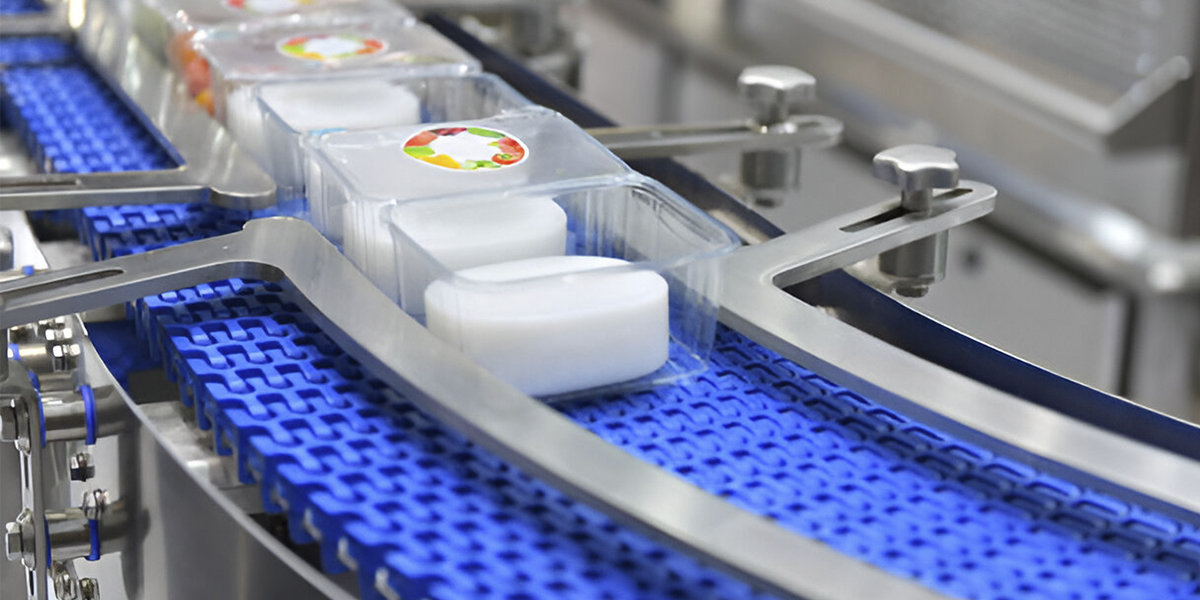
These properties reduce load on motors, minimize wear on mating components, and improve energy efficiency—especially in conveyor systems operating continuously in wet or chemically aggressive environments.
Strength vs. Performance: A Shift in Thinking
Stainless steel remains essential where extreme loads, high temperatures, or structural rigidity are required. But durability today is no longer defined by strength alone.
In corrosive environments, performance consistency over time matters more than theoretical strength. Engineering plastics deliver this consistency by resisting the very conditions that degrade metals.
Designing for the Environment, Not the Habit
The future of industrial design lies in material selection based on operating reality, not legacy habits.
Corrosive environments demand materials that do not fight the conditions—but coexist with them. High-performance engineering plastics are proving that, in the right applications, they don’t just match metal—they outperform it.
At Ultraplast, we work closely with manufacturers to evaluate material choices from a performance-first perspective. When systems are designed around the environment they operate in, reliability, hygiene, and efficiency follow naturally.