A smarter way to move products vertically
Rethinking Vertical Transport in Modern Manufacturing
In the evolving landscape of modern manufacturing, material movement isn’t just about speed — it’s about efficiency, safety, and precision. While horizontal conveying systems have been perfected over time, vertical or inclined transport remains a critical challenge for many industries. From food packaging to cold-chain logistics and pharmaceutical assembly lines, moving products upward or downward introduces complexities that flat belts and conventional systems often struggle to address.
Incline and decline conveyors must overcome issues like slippage, poor load control, large system footprints, and frequent wear — all of which contribute to higher maintenance costs and operational downtime. To address these pain points, manufacturers and OEMs are increasingly turning toward modular conveyor belts as a reliable, adaptable, and cost-effective solution.
What Makes Modular Belts Different?
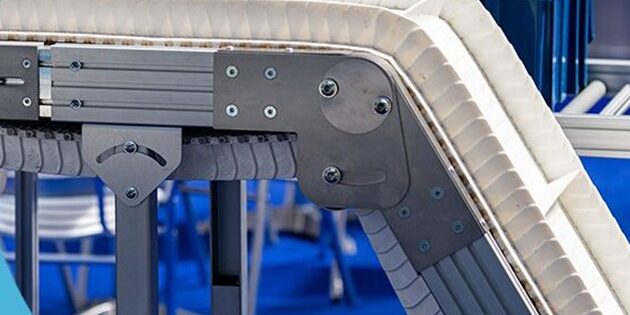
Modular belts are constructed from injection-moulded plastic segments (modules) that are interlocked and mounted on rods. These belts are driven by sprockets that engage with the underside of the modules — a positive drive system that contrasts with traditional friction-based belts.
This positive engagement is a game-changer, particularly in incline and decline applications. Unlike flat belts that can slip when transporting products at an angle or under varying loads, modular belts maintain a consistent, slip-free motion, even on steep slopes. This enhances safety, reduces product loss, and supports more predictable line performance.
Moreover, their segmented design means that they are inherently more durable and resilient under challenging conditions — from wet washdowns in food production to chilled zones in frozen storage.
Adaptability and Space Optimization
One of the biggest advantages of modular belts is their design versatility. They can be configured in straight, curved, Z-shaped, S-shaped, or even spiral layouts — making them ideal for operations where space is at a premium.
Traditional incline systems often require bulky mechanical setups or multiple transfer points to change direction or elevation. Modular belts simplify this. Their ability to curve, incline, and decline within the same system allows for streamlined layouts, minimizing the need for additional equipment and reducing the overall conveyor footprint.
This flexibility is especially useful in packaging plants, bottling units, and multi-level production facilities, where conveying systems must adapt to tight corners, different elevations, or fast-paced automation without sacrificing throughput.
Stability in Motion: Handling Products with Precision
When dealing with incline or decline systems, product stability becomes a top concern. Fragile items, slick packages, or lightweight units can easily slide or topple on steep belts — leading to jams, breakage, or inconsistent product spacing.
Modular belts solve this through design enhancements such as:
- Raised cleats or flights that hold products securely during elevation changes,
- Friction-enhanced surfaces that minimize sliding,
- Custom cleat heights and spacing depending on the product type and line speed.
This ensures that even sensitive items like pharma packs, snack pouches, or containers of varying weight stay perfectly in place throughout the movement. The result is smoother transitions, fewer stoppages, and a more controlled production flow.
Maintenance Made Simpler
Any maintenance engineer will tell you that belt failure is one of the most disruptive issues on a production line. Traditional belts — once torn or worn — often need complete replacement, which means system shutdown, labor costs, and production losses.
Modular belts take a fundamentally different approach. Only the damaged section needs replacement, not the entire belt. The modular nature of the design allows teams to remove and insert sections quickly, often without the need for special tools.
In addition:
- There’s less need for belt tensioning, which reduces wear on pulleys and bearings.
- The belts experience less stretch over time, maintaining alignment better.
- Spare part management is simplified — you stock modular links instead of full belts.
This translates to lower cost of ownership, minimal downtime, and better resource planning for maintenance departments.
Hygiene and Cleanability: Designed for Sensitive Environments
For industries that deal with perishable goods, medical products, or sanitary packaging, cleanability is non-negotiable. Modular belts are purpose-built for such applications.
Features include:
- Open-hinge construction for thorough washdowns,
- Smooth, non-porous surfaces that resist bacterial growth,
- FDA- and EU-compliant plastic materials safe for direct food contact,
- Fast drying surfaces that prevent mold or residue buildup.
This makes them ideal for meat and poultry processing, dairy production, confectionery, and pharma-grade cleanrooms where equipment must meet strict hygiene regulations without compromising performance.
Material Matters: Matching the Belt to the Environment
Another compelling strength of modular belts is the range of material choices available, allowing them to perform reliably in a variety of operational environments.
Depending on the specific requirement, belts can be manufactured from:
- Acetal (POM) – offering high stiffness and dimensional stability, ideal for bottling or high-speed lines,
- Polyethylene (PE) – suitable for cold or frozen environments due to its flexibility at low temperatures,
- Polypropylene (PP) – a lightweight, chemically resistant option for harsh cleaning or exposure to oils,
- Antistatic, flame-retardant, or UV-resistant grades for electronics or outdoor conveyors.
This material flexibility ensures that every line, regardless of industry or conditions, can have a belt that is truly fit for purpose.
Widely Trusted Across Industries
The growth in demand for modular incline and decline belts isn’t limited to one sector. Their multi-industry utility is a testament to their design innovation and real-world reliability.
Industries benefiting from modular systems include:
- Food & Beverage – hygienic, non-slip movement of packaged goods
- Pharmaceuticals – clean, vibration-free handling of fragile packs
- Cold Chain Logistics – robust belts that endure extreme temperatures
- Packaging & FMCG – smooth transport of varied SKUs across lines
- OEM Machinery – integration into compact, all-in-one systems for end users
Whether it’s a small packaging unit or a large-scale bottling facility, modular incline belts are proving to be the backbone of efficient and future-ready material handling.
Final Thought
As factories grow smarter and space gets tighter, conveying systems must evolve too. Modular conveyor belts for incline and decline movement represent that evolution — combining technical precision with practical performance.
They offer manufacturers the flexibility to design smarter systems, reduce waste, enhance hygiene, and cut long-term operational costs. For industries that demand reliability at every level, investing in modular technology isn’t just an upgrade — it’s a strategic move forward.
At Ultraplast India, we support OEMs and manufacturers with engineered conveyor components that meet the performance, hygiene, and customization standards of today’s advanced